


Page 4 - Hullarious Magazine, Volume One - 2022
P. 4
 Welcome to the
Book of Life
Sometimes things of inspiration and beauty come from the darkest places. And within that beauty, individuals can find worlds within worlds and interpretation of art can give it new life and purpose. Perhaps that is what is so enchanting about Hull’s School’s latest cultural addition to Huxley Hall.
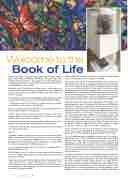
American artist David Kracov’s Book of Life at first glance is something to behold and instantly engages you with its explosion of colour and life when you enter the Hall. It also lends itself to a sense of wonder.
This is exactly what Hull’s School Chairman, Mr Hull hoped the effect would be as he reflected on choosing this extraordinary sculpture.
“It embodies the spirit of the school. It is about the joy of reading and thinking outside the box,” said Mr Hull.
Initially, it was Mrs Hull who spotted the work and thought it would be a wonderful edition for Huxley Hall.
“When I myself took a closer look at it, is was so very clear. Reading feeds you. The joyful colours of the butterflies, for me they illustrate that reading feeds our minds.”
“If we don’t read enough, we are mediocre. We don’t blossom, spread our wings, like the butterflies rising out of the book.”
“We don’t have the words to express ourselves. We don’t think with the same kind of depth...”
“Why?”
“Reading, contrary to being on the internet, is much more active. When I read a book I don’t see the pictures, I have to make the pictures. In other words, my imagination has to enter into play. Whereas, when I am watching a film or gaming or on social media my mind, my imagination is completely passive.”
“I am reacting and acting quite actively, but my imagination is basically lying dormant.”
Mr Hull says for him, “The Book of Life shows us what richness there is in reading books. Not just thought and words, but also a richness in feeling.”
“Again as I read a book my feelings are more in evidence than if I am watching a film,” he said. “They are mine, I make them. I am not reacting to someone else’s world with its own feelings, faces... all this appears in my imagination. So there is also an emotional side, which is quite important.”
“Kracov’s Book of Life with its colour and its flurry of butterflies also has a lot to say about the Psychology of reading.”
As a symbol of the school, it is one that clearly speaks of the beauty and importance of books and reading. However, there is so much more to the origins of this piece and the artist himself that it again shows, the unique place within life art holds. The ability to mean something different to all who engage with it. Yet, as with all art, what inspires the artist and what the eye of the beholder sees often can differ, allowing a piece to come alive and create a life of its own. In fact, many would suggest this is the embodiment of longevity. With each fresh interaction, a new story takes its first breath.
The Book of Life’s journey from the imagination of David Kracov to reality began as a way of honouring the late director of Chabad’s Children of Chernobyl, Rabbi Yossi Raichik, a man who saved thousands of children’s lives from the devastating effects of the Chernobyl disaster. The metal sculpture has pages filled with words from those Yossi touched, and also features a flurry of butterflies, each representing the 2,547 children he helped save and give new lives. Furthermore, the sculpture’s book, is also filled with text of poems, excerpts of diaries, and songs, written by children who died at Auschwitz, with the main poem The Butterfly, written by Pavel Friedmann. To date, through the Book of Life, Kracov has raised thousands of dollars to help these children of Chernobyl.
In fact, the Book of Life is one of a series of “Book Sculptures” Kracov has created, highlighting the importance the artist also places on the written word and its ability to transform the mind.
“I love to read, and from an early age enjoyed poetry. The words of Cummings, Frost, Plath, and Angelou, were like colours being applied to a canvas,” Kracov is quoted as saying on his website. “Watching an artist paint and seeing the colours applied and transform into what your mind wants to see is the same reaction I get from reading the words of prose and poetry. The words begin to form visions in my mind, transforming from a spoken to a visual experience.”
Yet, who is David Kracov? He is an artist who began building his portfolio aged 12 and is known as being the youngest artist to ever showcase in the Boston Museum of Fine Arts. After graduating from the prestigious Rhode Island School of Design Kracov pursued a career in animation where he kicked it off working on the Brad Pitt feature, Cool World. From there he held positions in the design teams of Disney Animation, Don Bluth Animation, Rich Animation, as well as working with Disney and Warner Brothers
HULLARIOUS 2


